Back
We're nostalgic for bad design
Why the friction and bad design from our early years still pulls at us, and what brands can do with that.

If you've watched Mad Men, you probably know the scene. It's the end of the first season. Kodak has built a slide projector with a round tray, they're calling it the Wheel, and they want the campaign to be about the technology.
Don Draper turns off the lights and clicks through slides of his own family. If you've been watching, you know he's already wrecking that family at home. Then he renames the projector the Carousel. A carousel goes round and brings you back to where you started.
"This device isn't a spaceship. It's a time machine."
It's one of the great pitches in television, and the projector barely gets a mention. Draper sells the feeling of going back.
I've been thinking about that scene because of something that doesn't quite add up. A lot of what people now feel nostalgic about was, by any usability standard, badly designed.
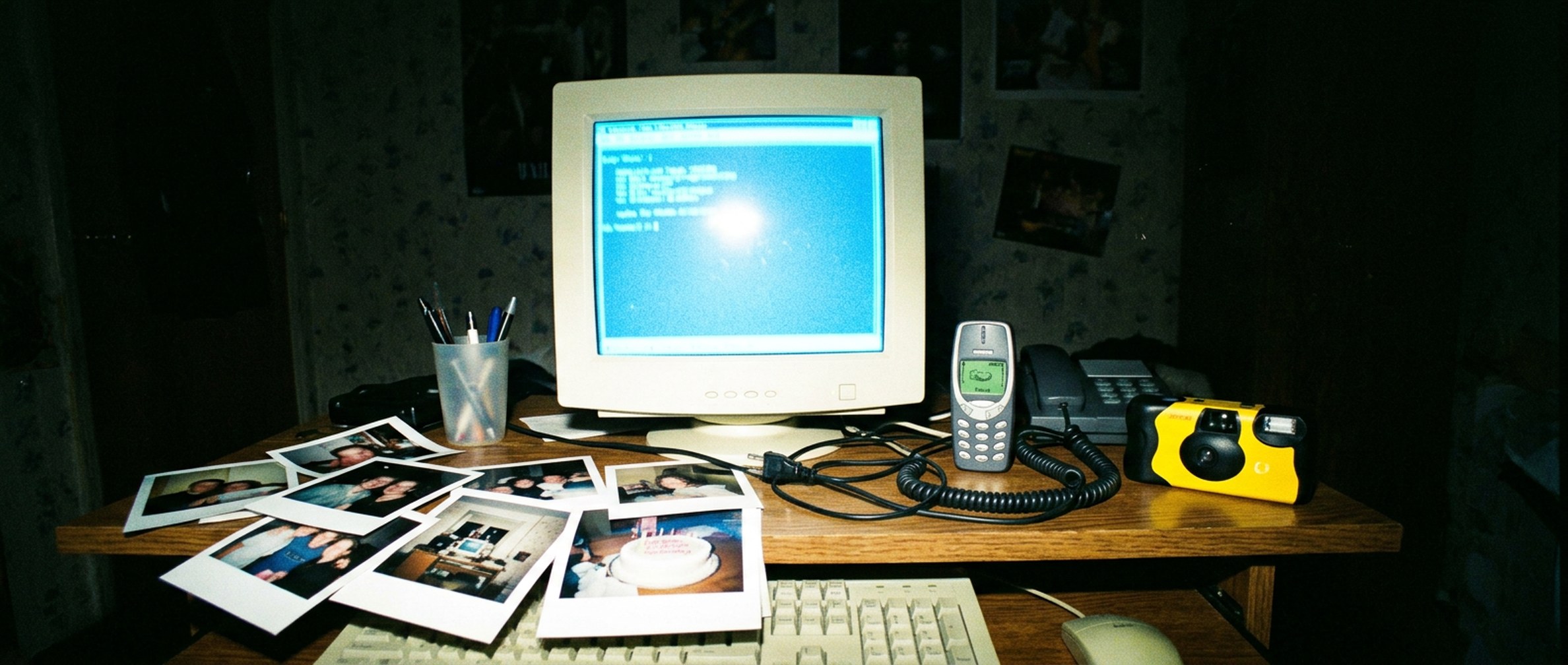
Think about the technology you lived with in the late 90s and early 2000s. The modem that screamed at you for a full minute before you could check one email. A phone where typing the word hello took thirteen key presses. A paperclip with eyebrows that popped up to tell you it looked like you were writing a letter, while you were writing a letter. Disposable cameras where you found out a week later that half the roll was your thumb.
We'd fail every one of those in a usability test today. I'd have failed some of them myself back then.
And yet most of us could still hum the dial-up tone, brag about their Snake or Tetris high scores, and remember the sound of that janky 8-bit ringtone they purchased for $2.99.
I should put my hand up here and confess to being a part of the friction. In the early 2000s I designed the ninemsn homepage, then redesigned it twice. Ninemsn was a joint venture between Microsoft, Channel Nine and ACP Magazines, and that homepage was the front door to hundreds of websites and channels from brands Australians grew up with. 60 Minutes, National Nine News, The Bulletin, The Wide World of Sports, Grazia and plenty more. If you opened Internet Explorer in Australia back then, it was the first thing you saw. On a big day it took 4-8 million views and was the most trafficked site in Australia.
Its job was to entertain you just long enough to pull you down the rabbit hole of the network and serve you some ads, and it did that job well. Everybody knew it and plenty of people hated it, but hardly anyone went there on purpose. It was simply there every time you went online, which is exactly how something ends up in the nostalgia pile.
I remember a few people in User Testing just described it as "where the internet started..." which i guess it was for them.
Most of those mastheads and programmes are gone now. The Bulletin printed its last issue in 2008. What I miss most is a front page where every link led to something a person had actually written and an editor had actually checked.
There's some good research on what nostalgia is actually for. A 2008 study in Psychological Science found that the loneliest people in its experiments were also the most nostalgic. When the researchers prompted nostalgia, people reported feeling more supported by the people around them. Nostalgia seems to do a social job. It reminds us we belonged somewhere.
It also changes how we treat money. Across six experiments published in the Journal of Consumer Research in 2014, researchers found that people who'd been thinking about the past were willing to pay more for products, and to give more money to others, than people thinking about the future. Their explanation is that feeling connected makes us less anxious about holding on to cash.
Think about what comes back when you remember your old Nokia. The Snake score you were trying to beat belonged to a mate. The disposable camera was full of a party you can't fully remember. The modem screech meant someone in the house was about to yell at you to get off the phone line because they needed to make a call.
The bad design sat right next to the people. Over time our memory has blended the two together.
Brands have noticed. The interesting part is which bit of the past they choose to bring back.
In 2017, HMD brought back the Nokia 3310 at Mobile World Congress in Barcelona. It had the familiar shape, a colour screen, a camera, Snake built in and a price of about US$50, roughly a third of what the original cost. It got the headlines everywhere. What it brought back was the object.
Four years later, an app called Dispo went the other way. It turned your phone into a disposable camera. You took photos through a tiny viewfinder, with no filters and no retakes, and you couldn't see any of them until 9am the next morning. By any modern UX measure that's a terrible idea. For a while it was one of the most downloaded apps in the App Store, and it raised a US$20 million Series A at a valuation of around US$200 million. The wait built anticipation and brought people back the next day. What Dispo brought back was the ritual.
Fujifilm's Instax has been doing this longer than anyone. It's a camera that gives you one slightly washed-out print you can't edit, and it has now sold more than 100 million cameras and printers since 1998. Instax has hit record sales five years running, and Fujifilm is investing 3 billion yen in its Kanagawa factory to lift film production 70% above 2022 levels by 2028. Fujifilm puts the success down to the texture of the prints and their analog feel, and pitches Instax as a way to communicate. I'd go further. An Instax print is made to be handed to someone. It's belonging you can hold.
Microsoft quietly removed Clippy from Office in 2007. Fourteen years later, in July 2021, it promised to swap its standard paperclip emoji for Clippy if a tweet reached 20,000 likes, and then announced him as part of an emoji refresh across Teams and Windows.
Microsoft's art director Claire Anderson explained the decision simply: "How could you not?" She also admitted that, like most nostalgic things, Clippy splits people.
Look at what Microsoft actually did. The most mocked assistant in software history came back as a tiny emoji, in a place where he couldn't interrupt anybody. They kept the character and left the behaviour in 2007.
There's another version of this, and it's the one I think about most. In 1998 I designed the Foxtel electronic program guide. We built it in Flash, fed it the listings through Macromedia's Generator, one of the first engines that could pour changing data into animated media, and it was a website that ran on air 24 hours a day. When I look at the Foxtel guide now, it's almost exactly what we designed back then. The screens are sharper and fit a few more lines, and that's about it.
Part of me wants to call that a missed opportunity. Mostly I feel a bit nostalgic every time I scroll through it. A grid of channels and times turned out to be something people never needed us to reinvent. Sometimes the kindest thing a brand can do with a design people grew up with is leave it alone.
Last year I wrote a whole piece, 'Tis But a Scratch, arguing that small UX cuts slowly bleed a product to death. I still believe it. Most friction is just friction, and nobody gets misty-eyed about a broken checkout.
But some friction is where the memory lives, and our industry has become very good at removing it without asking which kind it is.
If you're looking at a brand with a past worth revisiting, a few things to try:
Ask about the memory. In research, ask people who they were with and what they were doing when they used the old version. That tells you what's actually worth bringing back.
Keep one deliberate limit. Waiting until 9am, one print per shot, 27 photos on a roll. Pick the constraint that creates a moment and design it on purpose.
Drop the pain nobody misses. No one wants to lose half their photos to a thumb again, and nobody wants Clippy interrupting their emails.
Make it easy to share in person. The strongest nostalgia brands give people something to hand over, show off or do together.
Draper was right about the name. People don't want a wheel that only rolls forward. They want a carousel, and they want to see who's in the slides when it comes back round.
If you're sitting on a brand with some history in it, we'd love to talk about what's worth bringing back.
References
Lasaleta, J. D., Sedikides, C., and Vohs, K. D. Nostalgia weakens the desire for money. Journal of Consumer Research, 2014. Summary via ScienceDaily.
Zhou, X., Sedikides, C., Wildschut, T., and Gao, D.-G. Counteracting loneliness: On the restorative function of nostalgia. Psychological Science, 2008. Summary via Association for Psychological Science.
South China Morning Post, Indestructible Nokia 3310 is back, February 2017.
UX Collective, Dispo and the delight of delayed gratification, March 2021.
PetaPixel, Fujifilm has sold 100 million Instax cameras and printers since 1998, April 2025.
Digital Camera World, Instax is upping production again, October 2026.
ABC7 News, Microsoft is bringing back Clippy the paperclip, July 2021.


